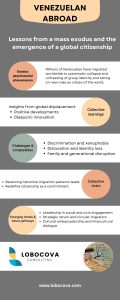

In recent decades, Venezuela has experienced one of the largest migratory phenomena in the history of Latin America. While much of the global narrative has focused on the political and economic dimensions of this displacement, a deeper analysis through the lens of social psychology and collective behaviour reveals a complex, transformative process at the level of individual and group identity. Venezuelans around the world are not only adapting to new societies—they are shaping new paradigms of global citizenship, intercultural exchange, and human resilience.
The Exodus as a Psychosocial Phenomenon
This mass migration is not merely a reaction to systemic collapse; it represents a collective reconfiguration of identity and purpose. Drawing on Kurt Lewin’s theory of social change, which posits that transformation requires an “unfreezing” of established structures, a transitional stage, and the eventual solidification of a new state, the Venezuelan diaspora is currently situated within a profound state of psychosocial flux.
Migrants often experience what scholars such as José Luis Pinillos identify as migratory grief—a multifaceted process involving emotional, familial, symbolic, and cultural loss. However, through this experience, many Venezuelans are participating in the emergence of a new form of consciousness that transcends national boundaries.
From Exile to Cosmopolitanism: The Rise of the Venezuelan Global Citizen
According to Social Identity Theory (Tajfel & Turner), group membership plays a significant role in shaping self-concept and intergroup dynamics. Venezuelans living abroad are engaging in a dynamic negotiation of identities—integrating into host cultures while also disseminating their values, narratives, and strengths. Through this dual process, we witness the formation of a transnational identity, marked by hybridity and intercultural fluency.
This evolving identity construct is giving rise to what we may term the “Venezuelan global citizen”—an individual who carries their cultural heritage with pride while actively contributing to global dialogue, development, and innovation.
Collective Learnings: Insights from a Global Displacement
Positive Developments:
- Collective Resilience: The experience of forced migration has catalysed an unprecedented level of resilience, adaptability, and problem-solving capacity. These are not just individual traits but are increasingly embedded in the Venezuelan cultural psyche abroad.
- Diasporic Innovation: Venezuelans are excelling in diverse fields—technology, healthcare, education, gastronomy, arts, and civil society. Their contributions are reshaping perceptions and actively enriching their host societies.
- Emergence of Solidarity Networks: Informal and formal networks of mutual aid have proliferated, reinforcing social cohesion and enabling strategic community organising across multiple countries.
Challenges and Complexities:
- Discrimination and Xenophobia: Many Venezuelan migrants face structural barriers, social exclusion, and stigmatisation. These experiences have significant implications for mental health and social integration.
- Dislocation and Identity Loss: The psychological toll of migration is marked by a disconnection from place and community, often leading to a sense of liminality or identity fragmentation.
- Family and Generational Disruption: The migratory process has disrupted traditional family structures, with long-term implications for intergenerational belonging and the socialisation of children in multicultural environments.
Collective Karma and Vision for the Future
From a psycho-spiritual perspective, this exodus may be interpreted as a collective karmic cycle. Venezuela—once a haven for immigrants from Europe, the Middle East, and neighbouring Latin American nations—is now experiencing the inverse. This historical reversal fosters a deepened collective empathy, humility, and awareness of global interconnectedness.
What is emerging is a population that understands citizenship not as a legal designation, but as a moral and existential commitment to humanity. Venezuelans abroad are redefining the notion of national identity, positioning themselves as contributors to a shared planetary future.
Emerging Trends and Future Pathways
- Leadership in Social and Civic Engagement: Increasing numbers of Venezuelans are assuming leadership roles within community organisations, NGOs, academia, and even local governance.
- Strategic Return and Circular Migration: A growing cohort of migrants is engaging in circular migration, returning temporarily or permanently with the goal of contributing to national reconstruction and transnational collaboration.
- Cultural Ambassadorship and Intercultural Dialogue: Venezuelans are increasingly seen as cultural mediators, facilitating intercultural understanding through the arts, education, culinary exchange, and storytelling.
The Venezuelan migration crisis is not only a humanitarian issue—it is also a laboratory of global transformation. Through adversity, a new global identity is emerging flexible, resilient, and consciously engaged with the challenges and possibilities of a shared human future.
From a social psychological standpoint, this mass displacement offers an opportunity to reimagine citizenship, belonging, and the power of collective adaptation. Venezuelans around the world are no longer just refugees of crisis; they are agents of renewal in an evolving global consciousness.